

Divide the House
The American Distraction at 250

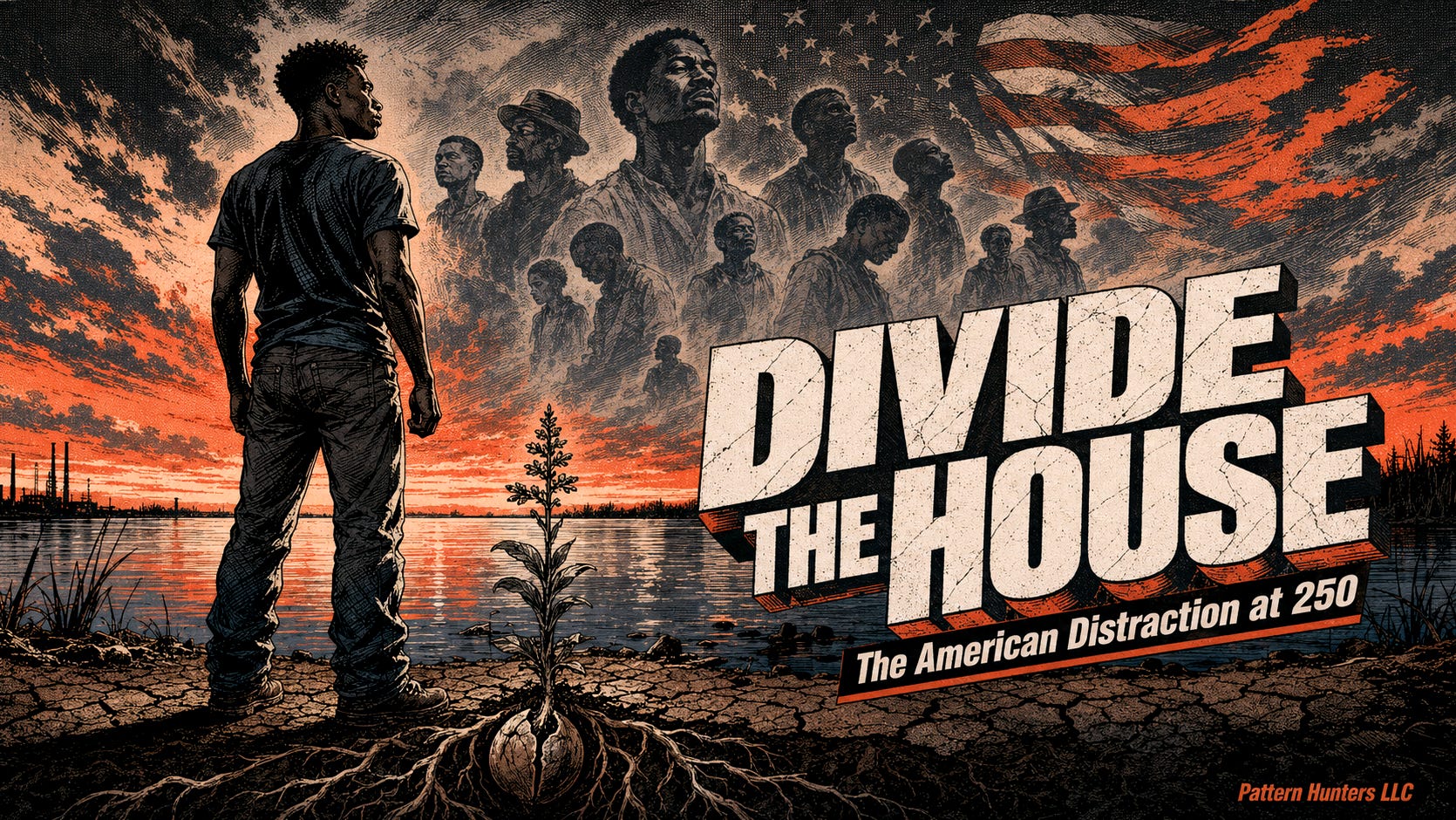
This analysis was originally published on patternhunters.com. Read the full piece, references, and complete research at patternhunters.com
I. The Lead: Horn Island, July 4, 2026
Nolan Xavier Wells was 18 years old.
He was a wide receiver at Southwest Mississippi Community College. He was supposed to report to training camp on Monday. He had his whole life in front of him. And on the 250th anniversary of the Declaration of Independence — July 4, 2026 — he went to Horn Island, a remote barrier island ten miles off the Mississippi Gulf Coast, with a group of friends.
His friends came back.
Nolan Wells did not.
Two days later, a U.S. park ranger found his body face down in the water near the island’s northwest shore. The Jackson County Sheriff’s Office said there was no immediate evidence of foul play. Civil rights attorney Ben Crump, retained by the family, told a different story: there had been a recorded altercation on the island. Wells’ phone had been taken by the people he went with. When the family received the phone, messages had been deleted. An independent autopsy, funded by Colin Kaepernick, is underway in Washington, D.C. Tyler Perry is covering the funeral expenses (CNN, 2026; Rolling Stone, 2026).
On July 11, 2026, a multiracial community gathered at the intersection of Government and State streets in Ocean Springs, Mississippi, and called his name out loud. Alfred Street Baptist Church in Virginia posted:
“The color of our skin should never determine the value of our lives, how we are treated, or whether we make it home safely. We are watching. The world is watching. And we will not look away.”
Mississippi. The water. A young Black man. Friends who left without him. A community demanding answers a system is slow to give.
Emmett Till was 14 years old.
He was visiting family in Money, Mississippi, in August 1955. He was accused of offending a white woman at a country store. Three days later, white men kidnapped him in the night, beat him savagely, shot him in the head, and threw him in the Tallahatchie River with a 75-pound cotton gin fan wired around his neck. His killers were acquitted by an all-white jury in 67 minutes (Bill of Rights Institute, 2023).
Seventy-one years separate Emmett Till from Nolan Wells.
Same state. Same water. Same silence from the system. Same family demanding answers.
Water is the silent accomplice of the Distraction. The system uses it to hide its sins — washing away evidence as it swallows Black boys and men whole. That is not a coincidence. These are the patterns that continue to shape our lives.
II. The Theory: The American Distraction (Hagan, 2004)
I have been saying this since 2004.
Not as a trend. Not as a hashtag. Not as a think-piece chasing the news cycle. As a theory — developed in a Newark classroom, carried into every lecture hall, every op-ed, every analysis I have written since the year I started teaching children who deserved the truth more than they deserved comfortable lies. The American Distraction. That is what I call it. And in the summer of 2026, as this country lights fireworks over 250 years of independence, I am saying it again — louder, with more evidence, and with considerably less patience.
Here is the theory in plain language:
Chaos is not a byproduct of broken governance.
It is the product.
A permanent, manufactured state of confusion, outrage, and exhaustion — engineered to prevent collective clarity and keep power exactly where it has always been. Not broken. Not accidental. Designed. The American Distraction is the oldest and most successful political technology this country has ever deployed. And it has been running, without interruption, for over 350 years.
George Orwell understood a version of this in 1949. In Nineteen Eighty-Four, his Party kept Oceania in a permanent state of manufactured war — rotating enemies, shifting alliances, perpetual crisis — so the people would never look inward and ask who was actually running the show.
“The masses never revolt of their own accord... so long as they are not permitted to have standards of comparison, they never even become aware that they are oppressed.” — George Orwell, 1949
Orwell saw the external enemy as the distraction. What I am naming is something more chronic, more specifically American, more rooted in the soil of this particular nation’s founding wound:
The enemy has always been internal. It has always been us, turned against each other. And the hand turning us has always been the same hand.
Neil Postman named the collapse of public discourse. Guy Debord named the society of spectacle. Naomi Klein traced the shock doctrine. Each of them saw a piece of it. But none of them named what I am naming — something that predates all of them, something built into the constitutional DNA of this republic before the ink on the Declaration was dry (Postman, 1985; Debord, 1967; Klein, 2007).
I learned to see it the way my mother taught me to read scripture. Not by taking anyone’s word for it. By going to the source, staying with the text, trusting what the evidence actually said. Show yourself approved. Study to know the truth. And when someone hands you a comfortable story, ask yourself who benefits from you believing it.
That is what I taught in Newark. That is what I carry into every piece I write. And that is what this analysis is going to do right now, in the summer of this nation’s 250th birthday — with full receipts.
III. The Seed (1676): How They Built the Technology
Before there was race, there was indentured servitude.
Black and white poor people stood on the same floor. Under the same contract. Eating together, drinking together, complaining together about the same master, the same conditions, the same boot on the same neck. They were not aligned because they were virtuous. They were aligned because they were on the same side of the power equation. And that alignment — that accidental, inconvenient, dangerous solidarity — was the single greatest threat the planter class had ever faced.
In 1676, Bacon’s Rebellion made that threat visible. A multiracial coalition of the poor — indentured servants, freed Africans, landless white laborers — rose together against the colonial elite in Virginia. They burned Jamestown to the ground. They scared the planter class into something it had never felt before: genuine existential fear. Not fear of one group. Fear of all of them, together (BlackPast, 2025; Facing History, 2016).
The response was not military. It was architectural.
The Virginia General Assembly began systematically codifying race into law. Whiteness was invented as a legal category — given privileges, given identity, given something to protect. And Blackness was invented as its legal opposite — stripped of rights, stripped of personhood, stripped of a future. Within a generation, the multiracial coalition that had burned Jamestown was dismantled. Not because the poor white laborer got wealthy. Not because his conditions improved. But because someone planted a seed in his mind.
“Yeah, you poor. You don’t have much. You don’t have a lot going for you. But at least you ain’t a nigga.”
That is it. That is the whole technology. You do not need to give a man wealth. You do not need to give him land, opportunity, or dignity. You just need to give him someone to look down on. And once that seed is in the ground, it grows on its own. It passes from parent to child. From generation to generation. From the plantation to the trailer park to the ballot box. From 1676 to 2026 without missing a single year.
Simultaneously — and this is the part that makes the American Distraction a masterpiece of political engineering — the same system told another man that his skin made him pure. That purity was all he had. That mixing, touching, loving across that color line would destroy the only thing that separated him from the bottom. Two lies running at the same time. One man told he’s better than nothing. Another man told his nothing is everything. The hand that planted both seeds? Never got dirty (Omi & Winant, 2015; Virdee, 2019).
In criminology, we call this racial formation — the social construction of racial categories as a mechanism of political and economic control (Omi & Winant, 2015). In political sociology, we call this hegemony — the process by which a ruling class manufactures the consent of the people it exploits by convincing them to internalize its ideology as their own common sense (Gramsci, 1971). In plain language, we call it a masterpiece of manufactured division — and it has been dividing this Gumbo Nation ever since. The seed planted in Jamestown in 1676 is the exact plant that grew the hemlock this nation is choking on in 2026.
IV. The Auction Block and the Architecture of Forgetting
Six days a week, under the domed rotunda of the St. Louis Hotel in the French Quarter of New Orleans, auctioneers sold enslaved human beings alongside land and livestock.
Not in secret. Not at night. In the middle of the day, in the middle of the city, in one of over fifty such sites operating openly in New Orleans alone.
That is not ancient history. That is the foundation on which this state’s economy, politics, and racial geography were built. Louisiana did not drift into its current relationship with Black bodies by accident. It was architectured — deliberately, legally, generationally — on the logic that some bodies exist to produce value for others. And the distraction’s job was to make sure nobody asked out loud who decided that.
Under partus sequitur ventrem — codified in Virginia in 1662, fourteen years before Bacon’s Rebellion — the doctrine mandated that the child follows the condition of the mother. If she was enslaved, her child was enslaved. Regardless of the father. Regardless of anything except the condition of her womb. Legal scholars describe it plainly: the doctrine hardwired the consumption and exploitation of Black bodies into America’s political and economic DNA. It treated enslaved women’s children as livestock — as property that ‘followed the belly’ of the dam (AAIHS, 2017).
This was the birth of what Ruth Wilson Gilmore (2007) calls carceral geography — the deliberate organization of space to contain, control, and extract value from Black life. The auction block was carceral geography. The plantation was carceral geography. The redlined neighborhood is carceral geography. The prison built on shuttered farmland in Louisiana’s rural parishes is carceral geography. The congressional district map drawn after Louisiana v. Callais to dilute Black political power is carceral geography. Same map. Different century. Same hand drawing the lines (Gilmore, 2007; Hawthorne, 2019).
Frederick Douglass understood what literacy would do before he fully understood slavery. The moment he learned to read, he said, he saw the path. Not just out of bondage — out of the lie. Because the lie requires your ignorance to survive. Teach a man to read and he will eventually read something that names his oppression accurately. Teach a woman to read the Bible for herself and she will find that the Son sets her free — and free indeed — and no plantation theology written by men who owned other men can stand against the actual text (Douglass, 1845; John 8:36, KJV).
That is why they made it illegal to teach enslaved people to read.
Not because Black people couldn’t. Because they could. And would. And the distraction cannot survive a literate population asking its own questions. It never could. It still can’t.
Which is why, in 2026, they came for sociology.
On March 26, 2026 — the same spring that Section 2 of the Voting Rights Act was gutted — Florida’s university system Board of Governors removed sociology from general education requirements at the state’s 12 public universities. On April 17, 2026, the State Board of Education did the same for the state’s 28 public colleges, bringing the total to all forty public postsecondary institutions in Florida. The state had already reviewed every existing sociology textbook and declared each one a violation of state law. They wrote a replacement. A University of Florida sociology professor called it an affront to academic freedom, and Florida International University’s Faculty Senate separately passed a resolution declaring the new textbook a violation of academic-freedom principles. The chancellor of Florida’s university system said the quiet part out loud: sociology “as a discipline is now social and political advocacy dressed in the regalia of the academy.” Introduction to Sociology at the University of Florida alone had enrolled roughly 1,450 students the year before it was eliminated (Florida State Board of Education, 2026; Inside Higher Ed, 2026; WUSF, 2026).
At the University of Texas at Austin, the leaders of the African and African Diaspora Studies program — home to the university’s Black Studies Collective — learned on February 12, 2026 that their department would be folded, along with American Studies, Mexican American and Latina/o Studies, and Women’s, Gender, and Sexuality Studies, into a single, blandly named Department of Social and Cultural Analysis. More than 800 students were enrolled across the affected programs. The Nation called it what it was: a coordinated assault, not a series of isolated bureaucratic decisions (The Nation, 2026; Literary Hub, 2026).
In March 2025, the Department of Education opened civil rights investigations against 45 universities for their participation in the PhD Project — a 32-year-old nonprofit that had helped more than 1,700 Black, Indigenous, and Latino students earn doctoral degrees in business. Thirty-one of those universities — including Yale, Duke, MIT, Ohio State, and Michigan — have since signed agreements cutting ties with the organization. Education Secretary Linda McMahon called it “the Trump effect in action.”
The new legal logic, stated plainly: any theory designed to acknowledge race in America is racist.
Peer-reviewed research published in Humanities and Social Sciences Communications in 2023 documents that nearly one-third of states had already banned curriculum that offers critical views of the racial past of the United States, and that over 200 bills restricting such curriculum had been introduced in 40 states as of that year — numbers that have only grown since, as the state-level actions described throughout this section confirm (Feinberg et al., 2023).
Frederick Douglass could have told them all of this in 1845. The discipline that names the system is always the first thing the system moves to eliminate. They made it illegal to teach enslaved people to read. They declared sociology illegal in Florida. They folded Black Studies into a department with no name. They opened federal investigations against universities that funded Black doctoral students.
The weapon is the same. Only the paperwork has changed.
You do not ban what does not threaten you.
V. The Music They Called the Devil’s Work
The American Distraction could not survive music.
Jazz was called the devil’s music. Not because it was sinful. Because white people were sneaking out to listen to it — sitting in the same rooms as Black people, feeling something true together before the system could sort them back into their proper places. The color line requires distance. Music destroys distance.
Rock and roll — Black music wearing a new name — did the same thing on a larger scale. It pulled bodies across the color line before the law could stop them. Every time two people from different sides of the distraction looked at each other and realized they were moved by the same thing, the architecture cracked a little more.
Hip Hop did it again. And they tried to call that the devil’s work too. But Hip Hop is not content. Hip Hop is epistemology. It is the largest unaccredited intellectual tradition in human history. When Tupac Shakur wrote Words of Wisdom in 1991 — “America! America! Ameri-KKK-a! I charge you with the crime of rape, murder, and assault, for suppressing and punishing my people” — that was critical race theory before the term got hijacked and turned into a bumper sticker. When KRS-One, hip-hop’s self-proclaimed “Teacher,” taught that the artist’s job is to inspire the student to become the teacher, that was pedagogy. When Public Enemy said fight the power, that was political science with a beat underneath it. When Boosie Badazz documented the grief of Baton Rouge in his catalog, that was Grief Criminology (Hagan, 2026) before it had a name (Rose, 1994; Chang, 2005).
Music has always been the thing that made people put down the distraction long enough to feel what they share. And power has always known it. That is why they come for the art. Every time. Without fail.
VI. Who Was in the Room (1776)
On July 4, 1776, a group of men declared independence from England by arguing that England was treating them like slaves.
Their word. Not mine.
While they were literally enslaving people three miles from where they wrote it.
Let us be precise about who stood around those tables. There was not one poor white farmer. Not one white woman — though Abigail Adams wrote to her husband John and asked him to “remember the ladies,” and history records how that turned out. Not one enslaved person. Not one Native American. Not one Asian person. Not one person from any community that would spend the next 250 years fighting for the rights that document claimed were self-evident. Wealthy, educated, land-owning white men wrote that document for wealthy, educated, land-owning white men. That is not an opinion. That is the historical record (Douglass, 1852; Smith, 1997).
“One Nation Under God, Indivisible, With Liberty and Justice for All.” Those words have never fully come to fruition for all. Not in 1776. Not in 1865. Not in 1965. Not in 2026. The American Distraction has seen to that. Two hundred and fifty years of a promise deferred.
Frederick Douglass stood before an audience in Rochester, New York in 1852 and asked:
“What, to the American slave, is your Fourth of July?”
His answer was a scorched-earth moral indictment of a nation celebrating freedom while practicing bondage. One hundred and seventy-four years later, Nolan Wells’ family is asking a version of the same question at the same time of year in the same state where Emmett Till’s killers walked free (Douglass, 1852).
The 14th Amendment tried to correct the original omission. Born in 1868, the Citizenship Clause declared that all persons born or naturalized in the United States are citizens. It was designed to overturn Dred Scott v. Sandford — to break the logic of partus sequitur ventrem. To say: you do not inherit your mother’s chains.
Plantation law said: you inherit your mother’s chains.
Racial law said: you inherit your one drop.
Constitutional law says: you inherit the soil beneath your first breath.
On June 30, 2026, the Supreme Court voted 6-3 to strike down an executive order that would have created a new category of hereditary non-belonging, upholding birthright citizenship as the law of the land. Five justices grounded that outcome in the 14th Amendment itself; Justice Kavanaugh supplied the sixth vote on narrower statutory grounds. The distraction tried to run its play. This time, the Court said no (Litman & Finch, 2026).
But two months earlier, that same Court issued Louisiana v. Callais — a 6-3 decision that gutted Section 2 of the Voting Rights Act of 1965. Justice Elena Kagan wrote in dissent that the Court had made Section 2 “all but a dead letter.” The League of Women Voters called it “the final blow dismantling the Voting Rights Act” (LWV, 2026; SCOTUSblog, 2026).
One hand gave. The other hand had already taken.
In 1676, the Virginia General Assembly codified race into law to break apart a multiracial coalition of poor people who threatened the power structure. Three hundred and fifty years later, the exact same legal mechanism — the deliberate dismantling of multiracial political power at the ballot box — was deployed again. The cast changed. The script did not.
The distraction is not a lie. It’s not a lie. It is an active, ongoing political operation — and it has been running longer than this nation has had a name.
This is what Pattern Hunters does. We connect the dots across time. We show you the pattern. And we let the pattern speak for itself.
VII. At the Dark End of the Street: The Missing and the Murdered
On September 3, 1944, Recy Taylor was walking home from church in Abbeville, Alabama. She was 24 years old. A sharecropper. A mother. Seven white men, armed with knives and shotguns, forced her into their car, drove her to a wooded area, and took turns raping her. The NAACP sent its best investigator to document the crime. Her name was Rosa Parks. Rosa Parks organized the Alabama Committee for Equal Justice for Mrs. Recy Taylor. The all-white, all-male jury never indicted a single man (McGuire, 2010; National Park Service, 2020).
Nine months before Rosa Parks refused to give up her seat on a Montgomery bus, a 15-year-old girl named Claudette Colvin did the exact same thing. She was arrested. The civil rights movement decided she was not the right symbol. She was a pregnant teenager. Her skin was the wrong shade. She did not fit the acceptable image of Black resistance. And so her name was erased from the front of the story, and Rosa Parks — whom Colvin herself called a mentor — became the face of a movement that Colvin had helped start. The distraction does not operate only through violence. It operates through erasure (Zinn Education Project, 2026; ASU News, 2025).
Emmett Till was 14 years old. Mississippi. 1955. Accused of speaking inappropriately to a white woman. Kidnapped, tortured, murdered, thrown in the Tallahatchie River. His mother, Mamie Till, insisted on an open casket. She said:
“I want the world to see what they did to my boy.”
Rosa Parks was in the audience at a mass meeting about Emmett Till four days before she refused to move on that bus. She said later she was thinking about him (Zinn Education Project, 2024).
That is the thread. Recy Taylor to Emmett Till to Claudette Colvin to Rosa Parks. All connected. All silenced in different ways by the same distraction. And all preceding what we are watching unfold in 2026.
The pattern has not stopped. It has only updated its tactics. Grief Criminology (Hagan, 2026) is the necessary lens to understand what follows — because the American Distraction does not only divide. It manufactures grief. It breaks down marginalized communities through cycles of loss, erasure, and institutional indifference, then converts that grief into statistics the system actively ignores. What you are about to read is not a list of tragedies. It is evidence of a deliberate operation.
According to the National Crime Information Center, Black people made up roughly 36% of all missing-persons entries in 2024 despite representing just 13–14% of the national population. One out of every three missing children in America is a Black child. The FBI’s NCIC entered 97,577 Black females into missing-person records in 2024 alone. Black girls between the ages of 11 and 21 are four times more likely to go missing than white peers. Advocacy groups, citing older Black and Missing Foundation estimates, put the number of Black women and girls currently missing in the United States somewhere between 64,000 and 75,000 (NNPA, 2025; Women’s Media Center, 2026; FBI NCIC, 2024).
Across all missing-person entries in 2024 — not Black children specifically — 95% were coded as runaways, a classification that removes them from AMBER Alert eligibility and reduces law enforcement resources allocated to their search; Black children are disproportionately represented within that runaway classification compared to white children (Hip Hop Democrat, 2026).
A peer-reviewed content analysis by Slakoff and Fradella found that white women and girls made up 68% of front-page missing-persons news coverage despite being roughly 59% of missing-persons cases, while Black women and girls made up only about 20% of that coverage despite being roughly 34% of cases. White female victims received substantially more repeated coverage and were more likely to receive sympathetic narratives. Black and Latina victims were more likely to be portrayed as risk-takers (Slakoff & Fradella, 2019).
In February 2026, Franceska Francois, 16, disappeared from Miami, Florida. No national media coverage. Serenity Layla Monique Hammonds, 16, missing from Leesburg, Florida since February 12, 2026. Morgan Renee Fairley, 16, missing from Lutz, Florida since January 15, 2026. Jaiilah Leshae Mitchell, 7 years old, missing from Newport News, Virginia since February 7, 2026 (The Root, 2026).
On June 18, 2026, the day before Juneteenth, Tonea Nicole Miller, 27, was found dead near Gwen Cherry Park in Miami, Florida. Originally from Flint, Michigan, she had been living in Miami since February 2026. The Miami-Dade Sheriff’s Office ruled her death a suicide with no evidence of foul play; part of her family has since said they accept that finding, while her sister continues to dispute it and has requested an independent autopsy (Mass Appeal News, 2026).
In Georgia, from January 2025 through May 2026: Christopher McKoy, 34, vanished after a rideshare shift, his car found, no sustained national coverage. Tremaine Moore, 41, found dead in the Savannah River with minimal follow-up. Kenny Darnell Jackson, 21, remains found in a wooded area in December 2025. Derek Samuel walked out of a Target in East Point and disappeared. His mother’s Facebook post, dated months later, said simply: “Still missing” (Final Call, 2026).
And on July 1, 2026 — three days before Nolan Wells disappeared — the community of Richland, Georgia was already grieving 19-year-old Zekevian James and 17-year-old Jo’Quavious Jones, found dead in a wooded area of Webster County. Double homicide. No arrests. No identified suspects. Almost no national media coverage (TheGrio, 2026).
Here is what some people will say when they read this far: What about Black-on-Black crime? If Black people are killing each other, why should anyone else care?
That is the distraction speaking. And it needs to be answered directly.
Black Americans are murdered at roughly six to seven times the rate of white Americans — a gap that has run as high as nearly eight times in some recent years. That is a real and devastating fact. But this does not mean Black people are inherently violent. It means Black people disproportionately experience poverty, limited access to quality education, joblessness, housing instability, and neighborhood disinvestment — all of which criminological research consistently links to higher rates of violence. The concentration of these conditions in Black communities is not an accident. It is the downstream consequence of 350 years of the American Distraction: redlining, mass incarceration, underfunded schools, the dismantling of the Voting Rights Act, the gutting of community infrastructure (Brookings, 2025; Uzzi et al., 2024; Baker et al., 2022).
Structural racism, measured at the county level, is significantly associated with higher Black firearm homicide rates and lower white homicide rates (Siegel et al., 2022). The violence in the community is not the root cause. It is a symptom of the root cause. And the root cause is the American Distraction — the deliberate, generational manufacture of the conditions that make solidarity impossible and self-destruction inevitable.
“Black on Black crime” is what happens when the distraction works so completely that the people it destroyed start destroying each other. That does not give anyone a license to dismiss Black death. It gives us one more reason to dismantle the system that created the conditions in the first place.
George Gerbner’s cultivation theory explains what happens next. When heavy media exposure consistently shows certain groups as victims worthy of rescue and other groups as statistics unworthy of coverage, those differential valuations become the normalized baseline perception of reality — not just for the public, but for the law enforcement officers making decisions about how quickly to respond, and for the editors making decisions about which stories run (Morgan, 2019; Callanan et al., 2015).
Intellectual suppression and physical neglect are two hands of the same distraction. They eliminate the vocabulary so you cannot name why the machinery sits quiet when a Black child disappears.
That disparity is not a coincidence. That is Kimberlé Crenshaw’s intersectionality — the term she coined in 1989 and developed further in her 1991 work on violence against women of color — made visible in the most human terms possible: a missing child, and the simultaneous compound of race, gender, class, and geography determining whether the full force of American attention arrives — or whether it doesn’t (Crenshaw, 1989, 1991; Powell et al., 2021).
Ida B. Wells named this pattern in 1892. In Southern Horrors: Lynch Law in All Its Phases, she documented the deliberate erasure of Black death from the national conscience as a mechanism of racial terror. One hundred and thirty-four years later, her journalism is still being confirmed by current events.
Recy Taylor. Emmett Till. Claudette Colvin. Franceska Francois. Tonea Nicole Miller. Zekevian James. Jo’Quavious Jones. Nolan Wells.
Do you know their names?
VIII. The Language They Stole
The American Distraction does not only manufacture confusion. At its most sophisticated, it takes the language you built to name your own survival and turns it into a weapon against you.
“Stay woke” was a survival instruction born in Black communities. A warning: pay attention, because the system will kill you if you don’t. It was passed from parent to child in the same tradition that says don’t go by what one person says — go find out for yourself. It was epistemic self-defense. And they took it. Twisted it into a political slur. Made it mean something it was never meant to mean. Campaigned against it. Put it on bumper stickers as the enemy.
“Black fatigue” means we are tired. Not in the way they have redefined it. Tired of explaining. Tired of proving. Tired of watching the pattern repeat itself with new names and the same outcome. Tired of running from a disease for 350 years without rest, without repair, without resolution. That is not a political position. That is a medical symptom.
“Critical race theory” was an academic framework for understanding how law produces racial inequality. It was turned into a campaign slogan before most of the people arguing about it had ever read a page of it. Now they are banning the sociology courses that would give students the tools to think critically about race at all.
W.E.B. Du Bois called this double consciousness — the experience of always seeing yourself through the eyes of a society that has already decided your worth.
“...the sense of always looking at one’s self through the eyes of others, of measuring one’s soul by the tape of a world that looks on in amused contempt and pity” (Du Bois, 1903).
The distraction needs you to see yourself the way it sees you. The moment you stop — the moment you develop what Du Bois called second sight, the ability to see the system clearly because you live inside its contradictions — the distraction has a problem.
The receipts have always been there.
If you paid attention in your history class. If you showed up to your civics class. If you sat through your sociology course — the one they are now working to eliminate — the evidence was being handed to you. The pattern was being named. The American Distraction has never hidden itself from people willing to look directly at it. It has only relied on the fact that most people won’t.
IX. A Nation Sick: Race as Public Health Crisis
Something is wrong with us.
It has gone so deep — the distraction, the seed, the hierarchy — that it runs automatically now. Before we know a name. Before we know a story. Before we know anything about a crime reported on the news, our first instinct is to ask: was it a Black person or a white person? That reflex was planted. It was watered. It was passed down. And now it maintains itself without instruction. That is what a successful distraction looks like after 350 years. It no longer needs an architect.
Race in America is a public health crisis.
Not a political problem. Not a social inconvenience. A disease — festering, progressing, breaking down the body from the inside. Structural racism is associated with higher rates of chronic kidney disease, diabetes, hypertension, preterm birth, and maternal mortality. Racial discrimination has a statistically significant positive association with adverse pregnancy outcomes across multiple international datasets. County-level structural racism consistently correlates with higher Black firearm homicide rates and lower white rates (Mohottige et al., 2023; van Daalen et al., 2022; Siegel et al., 2022).
The disease does not sort by income bracket when the body collapses. It does not sort by zip code. It spreads through the institutions — the courtroom, the classroom, the newsroom, the emergency dispatch center that decides how quickly to respond when a Black child is missing.
America is approaching the point of irreversibility.
Not in the abstract. In 2026. In the year it is lighting fireworks over 250 years of a promise it has never fully kept. And understand this — we are not even past the halfway mark. Everything you have read in this analysis — Nolan Wells in the water, Section 2 of the Voting Rights Act gutted, sociology eliminated from 40 Florida institutions, Black Studies folded into a nameless department in a 30-minute Zoom call, Franceska Francois missing from Miami, Zekevian James and Jo’Quavious Jones found dead in a Georgia wood, the PhD Project dismantled, 800 students enrolled in programs being erased — all of it happened between January and July 2026. Six months. We are in the second week of July — July 13, 2026. The year is not over. The distraction is not slowing down. It is accelerating.
Orwell’s warning applies here too: when the language is eliminated — when the courses are banned, the vocabulary is weaponized, the history is scrubbed — the people inside the system lose the standards of comparison that would allow them to recognize their own oppression. That is not an accident. That is the distraction in its most sophisticated form.
X. The Enemy Is Not Outside This Country
This nation has been told, for most of its 250 years, to look outward. The enemy is across the ocean. The enemy is at the border. The enemy is the immigrant, the foreigner, the other country, the outside threat that demands our unity and our sacrifice and our silence about the wound festering at home.
That is the distraction.
Orwell understood the mechanism in 1949: in his dystopian Oceania, the Party kept the population mobilized against rotating external enemies — Eurasia, Eastasia, it didn’t matter — so that no one ever looked inward and asked who was actually dismantling the foundations of their own society. The outrage was channeled outward. The real problem was never allowed into focus.
In America in 2026, the rotating external enemy is immigrants. It is other countries. It is the foreign threat that requires us to look away from the civil war of values happening inside our own borders. Because that is what this is. We do not need to worry about outside forces destroying this democracy.
We are doing it to ourselves.
This country has already fought one civil war over the question the American Distraction was designed to prevent: what does it mean to be American, and who gets to be? The answer cost 620,000 lives and still did not resolve the question. Reconstruction was dismantled. The Compromise of 1877 returned white supremacy to political power. The alliance between Black voters and white Republican reformers — the most dangerous multiracial coalition American politics had seen since Bacon’s Rebellion — was destroyed by organized violence and political betrayal.
We are in 2026 and the same question is on the table. The same coalition is under attack. The Voting Rights Act is gutted. Sociology is being banned. Black children are going missing at rates that should constitute a national emergency and are being classified as runaways instead. A young Black man disappeared in the water in Mississippi on the Fourth of July and the country is arguing about whether it was racial while his family waits for an autopsy.
The enemy is not outside. The enemy is the distraction itself. And the distraction is winning.
XI. The Coalition That Scares Power Most
The multiracial coalition is not a dream. It is a historical fact. It has existed before. And every time it has existed, power has worked — with violence, with law, with manufactured division — to destroy it.
Bacon’s Rebellion, 1676. James Chaney, Andrew Goodman, and Michael Schwerner — two white men from New York and one Black man from Mississippi, murdered together in Neshoba County in 1964 while registering Black voters. The Freedom Riders, Black and white together on those buses into the segregated South, knowing what was waiting for them in Anniston, in Birmingham, in the silence of a system that would not protect them unless it had to. Dr. King’s Poor People’s Campaign — his last campaign, the one that brought together poor people of every race to demand economic justice, the one he was supporting when they killed him in Memphis.
Viola Liuzzo. A white homemaker from Detroit. Murdered by the Klan on March 25, 1965, while driving marchers back from Selma to Montgomery. She had left her family to join the march after watching Bloody Sunday on television. The distraction could not survive what she represented: the moment when a white woman from Detroit looked at John Lewis being beaten on the Edmund Pettus Bridge and said,
“That is my problem too.”
And in Ocean Springs, Mississippi, on July 11, 2026, a multiracial community gathered at the intersection of Government and State streets and called Nolan Wells’ name. Churches across the country posted solidarity messages. Colin Kaepernick funded the autopsy. Tyler Perry paid for the funeral.
The hand that planted the seed is still holding the string. But the people it divided are starting to look up.
Envision what happens when the poor white laborer and the marginalized Black citizen look at each other and recognize — after 350 years — that they are on the exact same side of the power equation. That is the moment the spell breaks. That is the moment we stop fighting over the cheap seats and turn our collective gaze up to the owner’s box. That is collective healing in practice — not a hashtag, not a policy memo, but two people recognizing the same enemy at the same time.
The distraction cannot survive that recognition.
That is why it has worked so hard for 350 years to prevent it.
XII. The Reckoning: What God Requires
“In God We Trust.”
It is on the money. It is in the pledge. It was invoked at the founding of this nation by the same men who owned other human beings three miles from where they signed the Declaration. And it has been invoked in every generation since — by people building Zion with bloodshed while leaning on the Lord.
The prophet Amos was not speaking to pagans. He was speaking to the people who already had the covenant, who sat in the temple, who knew the name of God and used it as cover for their injustice. He said:
“Woe to them that are at ease in Zion, and trust in the mountain of Samaria... Ye that put far away the evil day, and cause the seat of violence to come near; that lie upon beds of ivory... but they are not grieved for the affliction of Joseph.” — Amos 6:1-6, KJV
Amos 6:12 makes it sharper:
“Ye have turned judgment into gall, and the fruit of righteousness into hemlock.”
They took the things meant to produce justice and poisoned them. They took a Voting Rights Act and poisoned it. They took a constitution that promised liberty and justice for all and poisoned it. They kept pushing the evil day further and further away — the day of reckoning, the day of accounting, the day when the question would finally be answered:
What did you do with what I gave you?
The prophet Micah named the same sin from a different angle. He addressed the leaders — the judges, the priests, the prophets — who ran the land with bribes, bent the law to favor the wealthy, and then went home and told themselves God was with them:
“The heads thereof judge for reward, and the priests thereof teach for hire, and the prophets thereof divine for money: yet will they lean upon the LORD, and say, Is not the LORD among us? none evil can come upon us.” — Micah 3:11, KJV
That last line is haunting. They are corrupt from top to bottom. And they are completely convinced God is on their side.
Consider the water. The system uses physical water to swallow Black boys and hide its sins — the Tallahatchie River in 1955, the waters off Horn Island in 2026, the Savannah River where Tremaine Moore was found with minimal follow-up. And the church sits in lukewarm water — neither cold nor hot — refusing to see any of it. Two kinds of water. One drowns. The other does nothing. And Christ said he was ready to spit out both.
That is the American Distraction in the church.
And then there is the church at Laodicea. The letter in Revelation 3 that Christ wrote to a congregation that was wealthy, comfortable, and completely convinced of its own spiritual health. He said:
“I know thy works, that thou art neither cold nor hot... So then because thou art lukewarm, and neither cold nor hot, I will spue thee out of my mouth. Because thou sayest, I am rich, and increased with goods, and have need of nothing; and knowest not that thou art wretched, and miserable, and poor, and blind, and naked.” — Revelation 3:15-17, KJV
The Laodicean church did not hate God. It was not evil in the obvious sense. It was indifferent. It had enough religion to feel righteous and not enough conviction to act justly. It sat on its pew every Sunday and said the right words and was not grieved for the affliction of Joseph. It was lukewarm. Comfortable. Distracted by its own prosperity and self-satisfaction.
Jesus said: I am about to spit you out.
Every congregation in America that has claimed God’s name while sitting in silence about 350 years of racial injustice is a Laodicean church. Every pew that has been warm and comfortable while Nolan Wells’ family demands answers. Every choir that has sung about heaven while Black girls disappear from Miami and no one in the sanctuary mentions their names. Every pastor who preaches about the afterlife without ever addressing the injustice happening in the parking lot.
“In God We Trust” — but we have not done what God requires.
Micah answered the question before anyone could ask it:
“He hath shewed thee, O man, what is good; and what doth the LORD require of thee, but to do justly, and to love mercy, and to walk humbly with thy God?” — Micah 6:8, KJV
Not sit on the pew. Not claim God’s protection while building Zion with bloodshed. Not invoke the Lord’s name while turning judgment into gall.
Do justly. Love mercy. Walk humbly.
The theological reckoning and the political reckoning are the same reckoning. The distraction runs through the church the same way it runs through the courthouse and the statehouse. It gives people a heaven to focus on so they do not fix the earth. It gives them a choir to sing to so they do not hear the cry of the missing child. It gives them a pledge to recite — “one nation under God, indivisible, with liberty and justice for all” — and distracts them from asking why that nation has never fully arrived for all.
Amos was not patient about this. He was not diplomatic. He said: the day of reckoning you keep pushing away is the one that will arrive first.
America is not exempt from that word.
XIII. Write the Vision, Make It Plain (Habakkuk 2:2)
The prophet Habakkuk cried out to God about injustice and was told:
“Write the vision, and make it plain upon tables, that he may run that readeth it.” — Habakkuk 2:2, KJV
That is the mandate of this work. Write it down. Make it plain. Put it where people can read it and run with it.
The ultimate defeat of the Distraction is collective literacy. Saying the names of the missing and teaching the history are acts of reading the world correctly — the same epistemic self-defense that made it illegal to teach enslaved people to read, the same threat that got sociology banned in Florida, the same fire that made them fold Black Studies into a nameless department in a 30-minute Zoom call. They have always known that a literate population is the one thing the Distraction cannot survive.
So here is the vision, plain:
We rise and fall together. That is not a slogan. That is a structural fact confirmed by 350 years of American history. There is no version of this story where one group falls and another watches from safety and comfort. The disease does not sort by race when the body collapses. Rich and poor. Black and white. Every ingredient in this Gumbo Nation. We built this together — some by choice, most by force — and we will either heal it together or lose it together.
The first step is to wake up. Not in the way they have politicized, mocked, and turned into a bumper sticker. Wake up in the original sense. The survival sense. The sense that says: pay attention, because what you don’t see will hurt you.
Go back to the source. Read the history for yourself. Show yourself approved. Do not take my word for it — go verify what I am saying against the historical record. The receipts are there. They have always been there. In the history textbook they are trying to remove. In the court opinions they are trying to ignore. In the census data they are trying not to collect. In the missing persons reports they are trying not to file. In the music they called the devil’s work. In the language they stole and flipped and turned into a campaign slogan.
The solidarity coalition has been built before. It has been destroyed before. But it has always — always — been the only thing power was ever truly afraid of.
James Chaney, Andrew Goodman, and Michael Schwerner understood that. Viola Liuzzo understood that. The multiracial vigil in Ocean Springs, Mississippi on July 11, 2026 understood that.
The distraction is working right now, while you read this. Someone is being handed the seed. Someone is being told that the person on the other side of the color line — the person with the same empty pockets, the same broken school, the same neglected neighborhood — is the enemy. And if enough people believe it long enough, we will not need any outside force to bring this country down.
We will do it to ourselves.
Christ told the church at Laodicea: I know you think you are fine. I know you think you have everything you need. But you are wretched, and miserable, and poor, and blind, and naked — and you do not know it.
Amos told the rulers at ease in Zion: you have pushed the evil day away for so long that you have forgotten it is coming.
Habakkuk was told: write the vision. Make it plain.
Two hundred and fifty years in.
The vision is plain.
Do not let the distraction steal the breath that you breathe.
Because if you don’t face it for what it is —
it will take everything.
References
African American Intellectual History Society (AAIHS). (2017). The invisible threads of gender, race, and slavery. https://www.aaihs.org/the-invisible-threads-of-gender-race-and-slavery/
ASU News. (2025, February 3). Hidden histories: Who is Claudette Colvin? https://news.asu.edu/20250203-arts-humanities-and-education-hidden-histories-who-claudette-colvin
Baker, R. S., et al. (2022). Structural racism, family structure, and Black-White inequality. Journal of Marriage and Family, 84(3), 785–808. https://doi.org/10.1111/jomf.12843
Banaji, M., et al. (2021). Systemic racism: Individuals and interactions, institutions and society. Cognitive Research: Principles and Implications, 6(82). https://doi.org/10.1186/s41235-021-00349-3
Bill of Rights Institute. (2023). The murder of Emmett Till. https://billofrightsinstitute.org/essays/the-murder-of-emmett-till
BlackPast. (2025). Bacon’s Rebellion (1676). https://blackpast.org/african-american-history/bacons-rebellion-1676/
Brookings Institution. (2025, February 28). Rethinking the role of race in crime and police violence. https://www.brookings.edu/articles/rethinking-the-role-of-race-in-crime-and-police-violence/
Callanan, V., & Rosenberger, J. S. (2015). Media, gender, and fear of crime. Criminal Justice Review, 40(3), 322–339. https://doi.org/10.1177/0734016814549776
Campaign Legal Center. (2026, May 20). The U.S. Supreme Court has eviscerated the Voting Rights Act. https://campaignlegal.org/update/us-supreme-court-has-eviscerated-voting-rights-act-whats-next
Chang, J. (2005). Can’t stop won’t stop: A history of the hip-hop generation. St. Martin’s Press.
CNN. (2026, July 9). Nolan Wells’ body was found after a July 4 boat trip. https://www.cnn.com/2026/07/09/us/nolan-xavier-wells-what-we-know
Crenshaw, K. (1989). Demarginalizing the intersection of race and sex: A Black feminist critique of antidiscrimination doctrine, feminist theory, and antiracist politics. University of Chicago Legal Forum, 1989(1), 139–167.
Crenshaw, K. (1991). Mapping the margins: Intersectionality, identity politics, and violence against women of color. Stanford Law Review, 43(6), 1241–1299.
Debord, G. (1967). The society of the spectacle. Buchet-Chastel.
Douglass, F. (1845). Narrative of the life of Frederick Douglass, an American slave, written by himself. Anti-Slavery Office.
Douglass, F. (1852). What to the slave is the Fourth of July? Rochester Ladies’ Anti-Slavery Society.
Dred Scott v. Sandford, 60 U.S. (19 How.) 393 (1857).
Du Bois, W. E. B. (1903). The souls of Black folk. A. C. McClurg & Co.
EURweb. (2026, March 16). Black, missing and disregarded. https://eurweb.com/black-missing-persons-crisis/
Facing History and Ourselves. (2016). Bacon’s Rebellion: Inventing Black and White. https://www.facinghistory.org/resource-library/inventing-black-white
Federal Bureau of Investigation. (2024). National Crime Information Center: Missing and unidentified person statistics. U.S. Department of Justice.
Feinberg, J., et al. (2023, February 2). Demobilizing knowledge in American schools: Censoring critical perspectives. Humanities and Social Sciences Communications. https://doi.org/10.1057/s41599-023-02161-4
Final Call. (2026, June 22). A forgotten population: Missing Black men receive limited media coverage. https://new.finalcall.com/2026/06/22/a-forgotten-population-missing-black-men-receive-limited-media-coverage-and-law-enforcement-response/
Florida State Board of Education. (2026, April 17). State Board of Education removes sociology from general education in the Florida College System. Florida Department of Education. https://www.fldoe.org/newsroom/latest-news/state-board-of-education-removes-sociology-from-general-education-in-the-florida-college-system.stml
Gilmore, R. W. (2007). Golden gulag: Prisons, surplus, crisis, and opposition in globalizing California. University of California Press.
Gramsci, A. (1971). Selections from the prison notebooks (Q. Hoare & G. Nowell-Smith, Trans.). International Publishers.
Hagan, A. (2004). The American Distraction [Original theory]. Pattern Hunters LLC.
Hagan, A. (2026). Grief Criminology [Original theory]. Pattern Hunters LLC.
Hawthorne, C. (2019). Black matters are spatial matters: Black geographies for the twenty-first century. Geography Compass, 13(11), e12468. https://doi.org/10.1111/gec3.12468
Hip Hop Democrat. (2026, March 3). America loses a child every 40 seconds, and nobody is looking for the Black girls. https://thehiphopdemocrat.com/2026/03/03/america-loses-a-child-every-40-seconds-and-nobody-is-looking-for-the-black-girls/
Inside Higher Ed. (2026, March 30). Florida deals another blow to sociology. https://www.insidehighered.com/news/quick-takes/2026/03/30/florida-deals-another-blow-sociology
Jacobs, H. A. (1861). Incidents in the life of a slave girl, written by herself. Published for the Author.
Klein, N. (2007). The shock doctrine: The rise of disaster capitalism. Metropolitan Books.
League of Women Voters. (2026, May 21). SCOTUS’s final blow dismantling the Voting Rights Act. https://www.lwv.org/blog/scotuss-final-blow-dismantling-voting-rights-act
Literary Hub. (2026, March 20). How Black Studies departments are being dismantled at American colleges. https://lithub.com/how-black-studies-departments-are-being-dismantled-at-american-colleges/
Litman, K., & Finch, M. (2026, June 30). Supreme Court upholds birthright citizenship on constitutional grounds. NPR. https://www.npr.org/2026/06/30/nx-s1-5839358/birthright-citizenship-decision-scotus-trump
Louisiana v. Callais, 608 U.S. ___ (2026). https://www.supremecourt.gov/opinions/25pdf/24-109_21o3.pdf
Mass Appeal News. (2026, June 26). Juneteenth: Black woman found hanging from a tree. https://www.massappealnews.com/2026/06/26/juneteenth-black-chick-found-hangin-from-tree/
McGuire, D. L. (2010). At the dark end of the street: Black women, rape, and resistance. Vintage Books.
Meer, N. (2018). W. E. B. Du Bois, double consciousness and the ‘spirit’ of recognition. The Sociological Review, 67(1), 47–62. https://doi.org/10.1177/0038026118780386
Mohottige, D., et al. (2023). Residential structural racism and prevalence of chronic health conditions. JAMA Network Open, 6(4). https://doi.org/10.1001/jamanetworkopen.2023.7647
Morgan, M. (2019). Cultivation analysis: Research and practice. Oxford Research Encyclopedia of Communication. https://doi.org/10.1093/acrefore/9780190228613.013.455
Morrison, T. (1987). Beloved. Alfred A. Knopf.
National Park Service. (2020). Mrs. Recy Taylor (1919–2017). https://www.nps.gov/people/mrsrecytaylor1919-2017.htm
National Newspaper Publishers Association. (2025, February). Missing & Black 2025 campaign. https://lasentinel.net/nnpa-launches-missing-black-2025-campaign-to-spotlight-disparities-in-media-coverage-of-missing-black-individuals.html
Omi, M., & Winant, H. (2015). Racial formation in the United States (3rd ed.). Routledge.
Orwell, G. (1949). Nineteen eighty-four. Secker & Warburg.
Postman, N. (1985). Amusing ourselves to death: Public discourse in the age of show business. Viking.
Powell, A., & Menendez, P. (2021). Gendered racial vulnerability: How women confront crime and criminalization. Law & Society Review, 55(3), 420–453. https://doi.org/10.1111/lasr.12556
Rolling Stone. (2026, July 9). Nolan Xavier Wells: What we know about 18-year-old’s death. https://www.rollingstone.com/culture/culture-news/nolan-xavier-wells-boat-island-death-what-we-know-1235591066/
Rose, T. (1994). Black noise: Rap music and Black culture in contemporary America. Wesleyan University Press.
SCOTUSblog. (2026, May 5). The Supreme Court’s indefensible evisceration of the Voting Rights Act. https://www.scotusblog.com/2026/05/the-supreme-courts-indefensible-evisceration-of-the-voting-rights-act/
Siegel, M., et al. (2022). Measuring structural racism and its association with racial disparities in firearm homicide. Journal of Racial and Ethnic Health Disparities, 9, 1202–1213. https://doi.org/10.1007/s40615-021-01076-x
Slakoff, D. C., & Fradella, H. F. (2019). The differential representation of Latina and Black female victims in front-page news stories. Feminist Criminology, 14(5), 599–642. https://doi.org/10.1177/1557085118760300
Smith, D. G. (1997). Citizenship and the Fourteenth Amendment. San Diego Law Review, 34, 681–748.
The Nation. (2026, May 18). The dismantling of Black Studies. https://www.thenation.com/article/society/black-studies-freedom-democracy/
TheGrio. (2026, July 8). The Nolan Wells case is reigniting conversations about other Black youth whose deaths raised questions. https://thegrio.com/2026/07/08/the-nolan-wells-case-is-reigniting-conversations-about-other-black-youth-whose-deaths-raised-questions/
The Root. (2026, March 3). If you see these missing Black girls, call for help. https://www.theroot.com/if-you-see-these-missing-black-girls-call-for-help-2000058915
Trump v. Barbara, 609 U.S. ___ (2026).
Uzzi, M., et al. (2024). Racial capitalism and firearm violence. Social Science & Medicine, 340, 116–458. https://doi.org/10.1016/j.socscimed.2023.116458
van Daalen, K. V., et al. (2022). Racial discrimination and adverse pregnancy outcomes: A systematic review and meta-analysis. BMJ Global Health, 7(2). https://doi.org/10.1136/bmjgh-2021-007657
van de Rijt, A., et al. (2018). Racial and gender differences in missing children’s recovery chances. PLoS ONE, 13(9). https://doi.org/10.1371/journal.pone.0203836
Virdee, S. (2019). Racialized capitalism: An account of its contested origins and consolidation. The Sociological Review, 67(1), 3–27. https://doi.org/10.1177/0038026118820293
Wells-Barnett, I. B. (1892). Southern horrors: Lynch law in all its phases. New York Age Print.
Women’s Media Center. (2026). Missing and murdered women of color: Research and advocacy. womensmediacenter.com
WUSF Public Media. (2026, April 17). Florida public colleges follow universities in scrapping sociology from core curriculum. https://www.wusf.org/education/2026-04-17/florida-public-colleges-follow-universities-in-scrapping-sociology-from-core-curriculum
Zinn Education Project. (2024, November 27). Rosa Parks, Emmett Till. https://www.zinnedproject.org/news/tdih/rosa-parks-emmett-till/
Zinn Education Project. (2026, February 27). Claudette Colvin refuses to give up her bus seat. https://www.zinnedproject.org/news/tdih/claudette-colvin/
Zinn, H. (2003). A people’s history of the United States. Harper Perennial.
Andrea Hagan is a criminologist, public scholar, and the founder of Pattern Hunters LLC.
patternhunters.com | Clarity. Advocacy. Power.